Diffusion Models
The stochastic.processes.diffusion module provides classes for generating
discretely sampled continous-time diffusion processes using the
Euler–Maruyama method.
-
class
stochastic.processes.diffusion.DiffusionProcess(speed=1, mean=0, vol=1, volexp=0, t=1, rng=None)[source]¶ Generalized diffusion process.
A base process for more specific diffusion processes.
The process \(X_t\) that satisfies the following stochastic differential equation with Wiener process \(W_t\):
\[dX_t = \theta_t (\mu_t - X_t) dt + \sigma_t X_t^{\gamma_t} dW_t\]Realizations are generated using the Euler-Maruyama method.
Note
Since the family of diffusion processes have parameters which generalize to functions of
t, parameter attributes will be returned as callables, even if they are initialized as constants. e.g. aspeedparameter of 1 accessed from an instance attribute will return a function which accepts a single argument and always returns 1.- Parameters
speed (func) – the speed of reversion, or \(\theta_t\) above
mean (func) – the mean of the process, or \(\mu_t\) above
vol (func) – volatility coefficient of the process, or \(\sigma_t\) above
volexp (func) – volatility exponent of the process, or \(\gamma_t\) above
t (float) – the right hand endpoint of the time interval \([0,t]\) for the process
rng (numpy.random.Generator) – a custom random number generator
-
sample(n, initial=1.0)[source]¶ Generate a realization.
- Parameters
n (int) – the number of increments to generate
initial (float) – the initial value of the process
-
property
t¶ End time of the process.
-
times(n)¶ Generate times associated with n increments on [0, t].
- Parameters
n (int) – the number of increments
-
class
stochastic.processes.diffusion.ConstantElasticityVarianceProcess(drift=1, vol=1, volexp=1, t=1, rng=None)[source]¶ Constant elasticity of variance process.
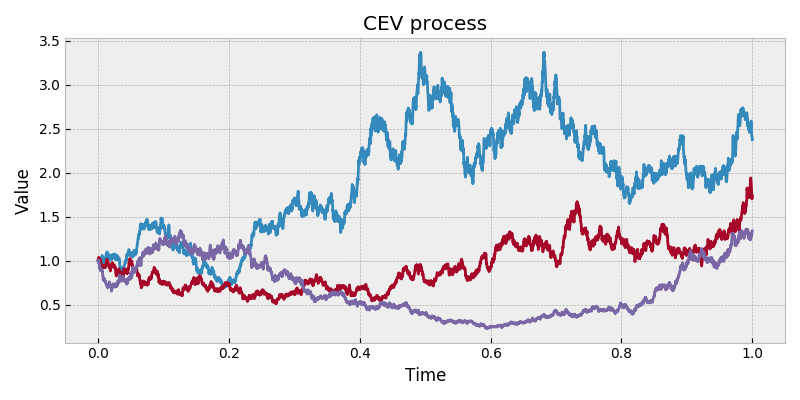
The process \(X_t\) that satisfies the following stochastic differential equation with Wiener process \(W_t\):
\[dX_t = \mu X_t dt + \sigma X_t^\gamma dW_t\]Realizations are generated using the Euler-Maruyama method.
Note
Since the family of diffusion processes have parameters which generalize to functions of
t, parameter attributes will be returned as callables, even if they are initialized as constants. e.g. aspeedparameter of 1 accessed from an instance attribute will return a function which accepts a single argument and always returns 1.- Parameters
drift (float) – the drift coefficient, or \(\mu\) above
vol (float) – the volatility coefficient, or \(\sigma\) above
volexp (float) – the volatility-price exponent, or \(\gamma\) above
t (float) – the right hand endpoint of the time interval \([0,t]\) for the process
rng (numpy.random.Generator) – a custom random number generator
-
sample(n, initial=1.0)¶ Generate a realization.
- Parameters
n (int) – the number of increments to generate
initial (float) – the initial value of the process
-
property
t¶ End time of the process.
-
times(n)¶ Generate times associated with n increments on [0, t].
- Parameters
n (int) – the number of increments
-
class
stochastic.processes.diffusion.CoxIngersollRossProcess(speed=1, mean=0, vol=1, t=1, rng=None)[source]¶ Cox-Ingersoll-Ross process.
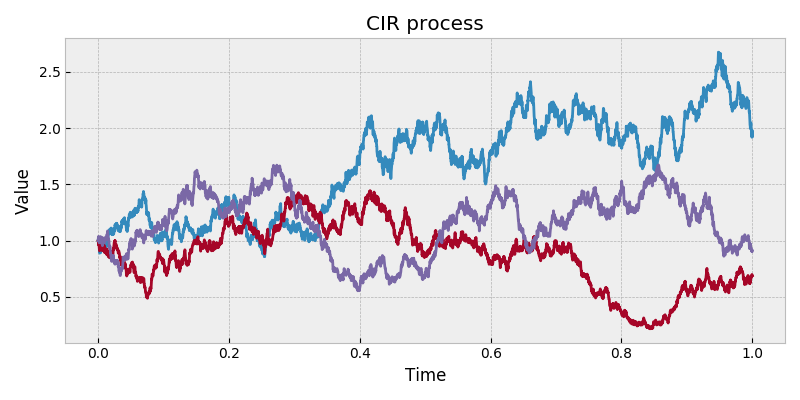
A model for instantaneous interest rate.
The process \(X_t\) that satisfies the following stochastic differential equation with Wiener process \(W_t\):
\[dX_t = \theta (\mu - X_t) dt + \sigma \sqrt{X_t} dW_t\]Realizations are generated using the Euler-Maruyama method.
Note
Since the family of diffusion processes have parameters which generalize to functions of
t, parameter attributes will be returned as callables, even if they are initialized as constants. e.g. aspeedparameter of 1 accessed from an instance attribute will return a function which accepts a single argument and always returns 1.- Parameters
speed (float) – the speed of reversion, or \(\theta\) above
mean (float) – the mean of the process, or \(\mu\) above
vol (float) – volatility coefficient of the process, or \(\sigma\) above
t (float) – the right hand endpoint of the time interval \([0,t]\) for the process
rng (numpy.random.Generator) – a custom random number generator
-
sample(n, initial=1.0)¶ Generate a realization.
- Parameters
n (int) – the number of increments to generate
initial (float) – the initial value of the process
-
property
t¶ End time of the process.
-
times(n)¶ Generate times associated with n increments on [0, t].
- Parameters
n (int) – the number of increments
-
class
stochastic.processes.diffusion.OrnsteinUhlenbeckProcess(speed=1, vol=1, t=1, rng=None)[source]¶ Ornstein-Uhlenbeck process.
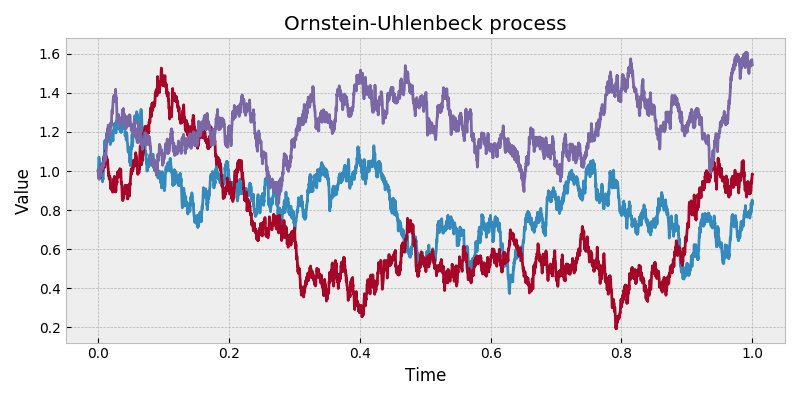
The process \(X_t\) that satisfies the following stochastic differential equation with Wiener process \(W_t\):
\[dX_t = - \theta X_t dt + \sigma dW_t\]Realizations are generated using the Euler-Maruyama method.
Note
Since the family of diffusion processes have parameters which generalize to functions of
t, parameter attributes will be returned as callables, even if they are initialized as constants. e.g. aspeedparameter of 1 accessed from an instance attribute will return a function which accepts a single argument and always returns 1.- Parameters
speed (float) – the speed of reversion, or \(\theta\) above
vol (float) – volatility coefficient of the process, or \(\sigma\) above
t (float) – the right hand endpoint of the time interval \([0,t]\) for the process
rng (numpy.random.Generator) – a custom random number generator
-
sample(n, initial=1.0)¶ Generate a realization.
- Parameters
n (int) – the number of increments to generate
initial (float) – the initial value of the process
-
property
t¶ End time of the process.
-
times(n)¶ Generate times associated with n increments on [0, t].
- Parameters
n (int) – the number of increments
-
class
stochastic.processes.diffusion.VasicekProcess(speed=1, mean=1, vol=1, t=1, rng=None)[source]¶ Vasicek process.
A model for instantaneous interest rate.
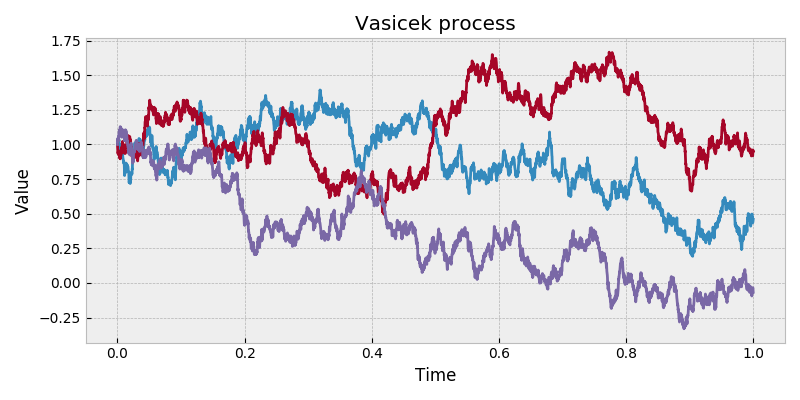
The Vasicek process \(X_t\) that satisfies the following stochastic differential equation with Wiener process \(W_t\):
\[dX_t = \theta (\mu - X_t) dt + \sigma dW_t\]Realizations are generated using the Euler-Maruyama method.
Note
Since the family of diffusion processes have parameters which generalize to functions of
t, parameter attributes will be returned as callables, even if they are initialized as constants. e.g. aspeedparameter of 1 accessed from an instance attribute will return a function which accepts a single argument and always returns 1.- Parameters
speed (float) – the speed of reversion, or \(\theta\) above
mean (float) – the mean of the process, or \(\mu\) above
vol (float) – volatility coefficient of the process, or \(\sigma\) above
t (float) – the right hand endpoint of the time interval \([0,t]\) for the process
rng (numpy.random.Generator) – a custom random number generator
-
sample(n, initial=1.0)¶ Generate a realization.
- Parameters
n (int) – the number of increments to generate
initial (float) – the initial value of the process
-
property
t¶ End time of the process.
-
times(n)¶ Generate times associated with n increments on [0, t].
- Parameters
n (int) – the number of increments